
You aren’t going to get far in the world of Chillies without running across the Scoville Scale. But what is it?
It is simply the best known method of rating the heat you can expect from a chilli, normally shown as SHU (Scoville Heat Unit). It measures the amount of capsaicin found in our favourite fruit.
Capsaicin? – That’s the chemical that gives you the burning sensation when the fruit from a member of the Capsicum family of plants is eaten.
Right down at the bottom of the Scoville Scale you’ll find a Bell Pepper registering at 0 SHU, the popular Jalapeno chilli is around 3,500 to 8,000 SHU and the current record holder, Carolina Reaper is about 1,500,000 SHU (though it has reached over 2,200,000!).
How it came about however isn’t quite as simple.
 Back in 1912 an American Pharmacist named Wilbur Scoville devised a method of testing Chillies while working at the pharmaceutical company Parke, Davis & Co.
They were interested in using capsaicin in a new muscle salve. Before they could continue with their research they would need a way to measure the piquancy (or, heat) of the chillies. They’d found that too much capsaicin would cause their salve to have an unpleasant burn to the skin and if they don’t use enough the salve wouldn’t be effective.
Wilbur had already got a proven track record with such things having published books on similar subjects and so was tasked with devising a new method to do just that.
It was then that the Scoville Organoleptic Test was born, or simply the Scoville Scale as it is known today.
Mr. Scovilles method took a determined weight of dried chillies and dissolved them in alcohol overnight to extract the capsaicinoids (the part that gives chillies their heat).
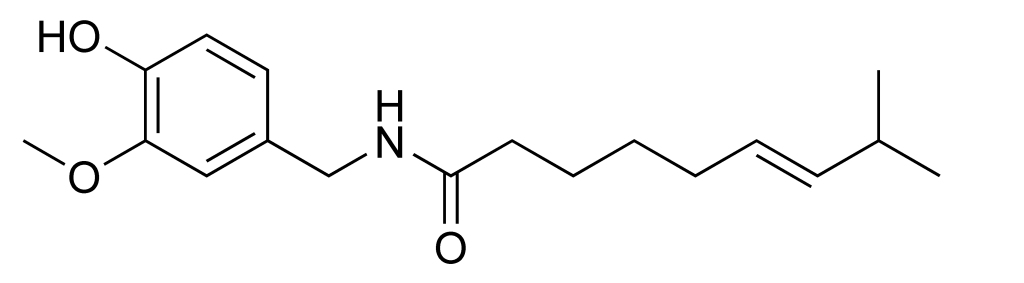
Capsaicin Chemical Structure
He’d then take this alcohol solution to five specially trained testers and have them dilute the solution with sugar water until they could no longer sense any heat.
When three of these five could no longer feel heat, that’s when the chilli was given its Scoville Heat Rating, or SHU. The SHU is determined based on the dilution of sugar water rated in multiples of 100.
So, if you have chilli such as the Jalapeno which has a Scoville rating of 3,500 – 8,000 this would mean it took at least 3,500 dilutions before heat was undetectable in the solution.
But this obviously wasn’t perfect, as we all know the heat of chillies is very subjective. Taking again the humble Jalapeno for example, most can eat these and find them quite spicy but give a dish a nice heat. Other people can’t eat them at all and deem them too hot. To an experienced chilli head they barely register any heat at all most of the time, though they are still very tasty.
Even if you are a person who finds them spicy to begin with, you become accustomed to them and over time they lose their heat. This can even happen over the course of a meal! Put them on a sandwich and at the start they’ll be hot, by the time you get to the end they’ll be tangy.
Then of course you’ve got the opposite building effect that some chillies such as Habanero will give you, the more you eat, the hotter they seem to get.
And then there is the chillies themselves, some can simply be hotter than others dependent on various factors when grown. Humidity, sunlight available to the plant, soil type and the fertilizer used can come into play. And, even shouting at the plant, allegedly.
Once again going back to the Jalapeno, some of those can take even the most seasoned chilli head by surprise if you get caught by one with ideas above it’s station in life.
On the lower end of the Scoville Scale this doesn’t matter too much but once you start talking about the Carolina Reaper with its starting point of 1,500,000 SHU and ending point of 2,200,000 SHU then it’s quite the difference.
So while The Scoville Scale may be the best known method of measuring the potency of a chilli, it isn’t necessarily the best method.
The more modern method is High Performance Liquid Chromatography. Well, I say modern, it’s been around since the 1980’s. I won’t pretend to understand all the science and Voodoo associated with HPLC, but there is an equation that lets cleverer people than me convert the HPLC result for capsaicinoids found in a fruit back into Scoville Units.
Which when you think about it, the nod to Wilbur Scoville is kind of cool.
And the original muscle salve that all of this came from? HEET Liniment.

The final product ended up using a quantity of just 0.25% of capsaicin.
Unfortunately it seems that HEET itself has been discontinued at the time of writing. It’s a bit of a shame that we’ve lost that part of Chilli history but I guess it’s legacy lives on.
Of course, over the years many more manufacturers would include capsaicin in their products and today and many can be found on the market today.
From personal experience I have to say that they’re pretty effective at their job, at least for RSI.
That isn’t to say you should just go ahead and rub the chilli oil from inside a chilli directly on to your skin. Anyone who has spent time deseeding chillies will tell you that is a bad idea.